Visit to Telford’s Bridge Conwy 200
On a warm Thursday afternoon, 18th June, about 20 members of the history group gathered at the Conwy Tunnel Commemorative Arch on the eastern side of the estuary, to start our 1st trip of 2026. The Arch’s “blocky design” was chosen to replicate the immersed tube construction of the main tunnel, so different to our subject for today’s talk.
Our walk and talk was lead by our committee member Diane Williams and Paul Reed who is a keen local historian. Both Diane and Paul are Gold Tourism Ambassadors for Conwy, and White Badge Official Tourist Guides for Conwy. We walked along the embankment, locally known as the cob, towards Conwy castle and the suspension bridge built by Telford in 1826. It had rained earlier that day and the weather forecast was light rain, so most of us were prepared with raincoats and brollies!
Once on the suspension bridge Diane gave us a quick run through history of why the bridge was built and the political decisions at the time. We take a lot of it for granted today, but the crossing of the Conwy river safely throughout the year was an essential part of life in the UK. Following the Acts of Union in 1800, members of the Irish Parliament and the peerage had to commute frequently between Dublin and Westminster. They used the Holyhead Road, which was the main communication link between London and Ireland at the time.
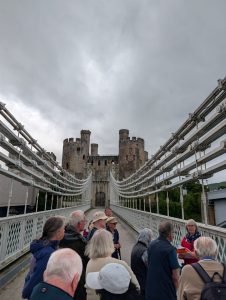
Pre-1826, carriages and horses were driven onto small, unreliable ferries to cross the River Conwy and the Menai Strait. The crossings were highly dangerous, frequently suspended in bad weather, and delayed by 12-hour tide cycles. To appease frustrated Irish MPs and facilitate swift passage of the mail, the British government funded extensive road and bridge improvements championed by engineer Thomas Telford. The completion of the Conwy Suspension Bridge (1826) and the Menai Suspension Bridge (also 1826) allowed coaches to drive directly across, drastically reducing travel. By the mid-1840s, the arrival of the North Wales Coast Railway replaced the stagecoaches, significantly speeding up the journey from the Irish Sea ports to London.
After Diane’s talk, Paul gave us a technical description of the bridges currently in situ and explained about other smaller bridges that existed to carry pedestrians and utility services between Conwy and Llandudno Junction. He pointed out physical evidence where these bridges were located and how they were constructed.
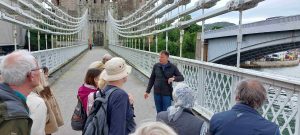
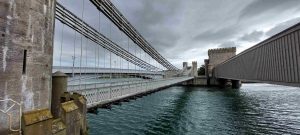
When the new road bridge was built in 1958 alongside the suspension bridge, these smaller bridges became superfluous and were removed. In fact a decision was taken to dismantle Telford’s Suspension bridge, but thankfully that was removed after a huge local uproar and campaign successfully halted these plans, saving the 1826 structure so it could be passed into the care of the National Trust.
Later Telford’s bridge faced another survival test. During maintenance in 1989, engineers discovered that historical strengthening of the road deck had tripled the bridge’s weight, leading to severe corrosion. By carefully dismantling and lightening the structure to remove the vehicular strain without losing Telford’s original fabric, experts were able to retain the chains and restore the bridge to its stunning 1896 appearance.
Our chairman Kevin thanked both Diane and Paul for their extremely interesting talk on Telford’s suspension bridge and the group thanked them in the traditional way of a warm applause. Thankfully the forecasted rain held off until the end of Paul’s talk so we remained dry!
Trefor Price
Latest Research